
Pushing for Spanish Language Services for the Hispanic Community
By Sen. Leo Jaramillo (NM)
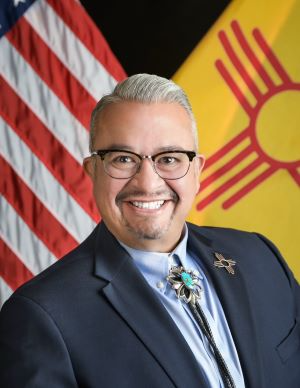
By Sen. Leo Jaramillo (NM)
Download the 2025 Fall Edition here.
In recent years, the Hispanic and immigrant communities in the United States have continued to face major obstacles in accessing vital services. The COVID-19 pandemic highlighted some of these obstacles, particularly regarding access to healthcare and public health information and guidance, as well as accessibility to enrollment in the public education system. These issues are leaving non-English speaking families in the US behind, denying them basic rights. Legislators and policymakers, both state and federal, must prioritize addressing this situation to ensure compliance with civil rights laws and to promote equity, civic participation, and trust in public institutions.
Of the over 22 million people in the US with limited English proficiency, close to two thirds are Hispanic, and as Hispanic communities continue to grow, it is important for the federal and state governments to provide more accessible services to non-English speakers in our country. Language barriers mean that a massive number of families across the country miss out on essential government services such as healthcare, education, and courts. This issue isn’t just about language, it’s about dignity and equal opportunity.
For example, during the COVID-19 pandemic, many Spanish speakers were unable to access critical public health information including vaccination, which left the Hispanic population disproportionately uninformed. This disparity highlights a persistent issue: Title VI of the Civil Rights Act of 1964 requires “meaningful access” to state services, but in many cases, compliance is inconsistent. Currently, some state agencies across the country fail to provide information and forms in multiple languages, and schools lack sufficient bilingual staff, among other issues.
New Mexico may not carry a formal bilingual mandate, but the state continues to honor its heritage by ensuring vital information reaches New Mexicans in both English and Spanish. And states like California and New York have established comprehensive language access laws requiring translation of forms and interpreter services. California passed Government Code §11135, which draws heavily from Title VI of the Civil Rights Act, requiring that all individuals have full access to the services provided by state agencies. In New York, the state provides access for the top 12 non-English languages spoken, and New York City provides interpretation for over 100 languages.
Another positive advancement in offering multilingual government services is that, until now, Medicaid has been very active in providing services for its non-English speakers, mainly those who speak Spanish. Barring Alaska, forty-nine states translate online applications and documents on the Medicaid website. However, there are still noticeable gaps in accessibility, with most translated information being seen as less reliable than the information in English, and most translations taking only Spanish speakers into account.
State legislators should focus on requiring agencies to translate their websites, as well as essential documents into the most common non-English languages, similar to New York’s top 12 languages policy. In addition to this, legislators should advocate and push for funding interpreter services, as well as partnering with local groups that focus on serving LEP communities within their respective districts. It’s important to stress that these policies should be done to offer Hispanic constituents a fair experience in dealing with and seeking assistance from state agencies.
Section 202-A of the New York Executive Law, Language Translation Services, provides a good framework for new, similar legislation in other states. By using data that appears in the most recent American Community Survey published by U.S. Census Bureau, states can designate how many languages can be used for state websites. Some states may not need a top twelve, but rather a smaller amount that more accurately accounts for their LEP population. NHCSL’s own Res. 2021-09, Making State Legislatures More Accessible to America's Diverse Population by Increasing Translation and Interpretation Services in Our State Capitols, establishes several terms for the breaking down of language barriers for our communities and highlights the advancements made already in several states. The aforementioned law and this resolution give policymakers a framework for legislation that can create accessibility and provide resources for our communities across the country.
Legislators across the Nation would benefit greatly from pushing for better access to resources for individuals with LEP, as this would bring in more individuals to participate in civic life and duty, as well as give legislators more insight into the problems and needs of their constituents and communities.