
2025-16
Out of the Shadows, Into Dignity
Supporting Enactment of The Dignity Act by this 119th Congress, to Advance Comprehensive Immigration Reform

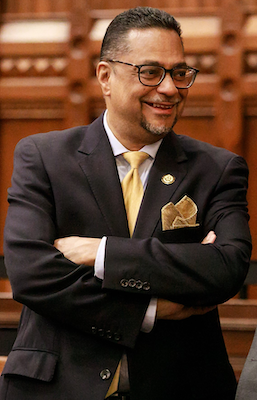
Sponsored by
Rep. Angela Martinez (KS) and Rep. Geraldo Reyes (CT)
Reported to the Caucus by the
NHCSL Immigration Task Force
Rep. Louis Ruiz (KS), Chair

Unanimously ratified by the Caucus on November 22, 2025
WHEREAS, this caucus has consistently called on Congress to pass meaningful comprehensive immigration reform, taking on the issue in Resolutions 2006-6, 2009-12, 2012-09, 2013-11 and 2018-08, stressing that “the United States of America as a country of immigrants… bound together by national values of economic opportunity as reward for hard work, known far and wide as the American Dream,”[1] and, from the outset, condemning the building of border walls while supporting humane ways to secure the border;[2] and,
WHEREAS, foreign-born workers comprised nearly one in five participants in the U.S. labor force in 2024,[3] and undocumented immigrants form a substantial share of certain key industries. Notably, an estimated 12.7 % of agriculture workers, 13.7 % of construction workers, and 7.1 % of hospitality workers are undocumented;[4] and,
WHEREAS, on June 12th, an internal memo from U.S. Immigration and Customs Enforcement temporarily halted deportation operations targeting farms, restaurants, hotels and meat-packing plants, following employers’ complaints over labor shortages and economic profit loss resulting from immigration raids;[5] and,
WHEREAS, following the agency’s temporary halt, President Trump wrote in a social media post that the administrations’ aggressive policy on immigration is “taking very good, long-time workers away from them [hotel and leisure businesses], with those jobs being almost impossible to replace;”[6] and,
WHEREAS, by June 16th, ICE resumed intensified enforcement operations, including mass worksite raids across multiple states. As a result, the agricultural industry saw a total drop in employment of 6.5% from March 2025 to July 2025.[7] Reflecting not only the devastating impact of deportations, but the terror that immigration enforcement operations have created in communities, leading immigrant workers not to show up to work; and,
WHEREAS, for every million undocumented immigrant workers deported, an estimated 88,000 U.S.-born workers lose jobs, illustrating the interdependence of the labor market on immigrant labor and purchasing power;[8] and,
WHEREAS, undocumented immigrants paid a total of $96.7 billion in federal, state, and local taxes in 2022. Of that total, $59.4 billion went to the federal government and $37.3 billion towards state and local governments. Recognizing that immigrant groups often pay taxes at a higher rate than native-born or other authorized workers in most states, contributing 26.1% of their income;[9] and,
WHEREAS, providing access to work authorization for undocumented immigrants would increase their tax contributions, by amplifying opportunities to earn higher wages. Under a scenario where work authorization is provided to all current undocumented immigrants, their tax contributions would rise by $40.2 billion per year to $136.9 billion;[10] and,
WHEREAS, the National Hispanic Caucus of State Legislators has called on Congress to expedite a pathway to citizenship for immigrant children, highlighting DACA recipients, who complete an academic education or military service, to become fully integrated members in their communities and incentivize a thriving national economy;[11] and,
WHEREAS, a 2024 sample study conducted by the Center of American Progress from a pool of 433 DACA recipients across 39 states, reported 92.4% of respondents were currently employed and 62.8% had a bachelor’s degree or higher;[12] and,
WHEREAS, as of December 31, 2024, there were 533,280 active DACA recipients, whose households pay $8.7 billion in federal, state, and local taxes each year. Contributing $24 billion in after-tax spending power to stimulate the national economy.[13] Demonstrating how rooted dreamers are in the fabric of American society; and,
WHEREAS, comprehensive legislative reforms creating a pathway to citizenship or legal status for immigrant workers and DACA recipients would encourage immigrants out of the shadows to dignify their lives and honor the role they play in American prosperity; and,
WHEREAS, in Resolution 2018-16 Regarding an End to the Separation of Migrant Families and Reject the Detention of Children and Families, NHCSL highlighted an urgency to properly address the humanitarian crisis at the southern border. By treating asylum seekers humanely and with dignity inside our borders instead of illegally refusing to accept asylum-seekers at designated Ports of Entry (POEs); and,
WHEREAS, NHCSL condemned the actions of federal enforcement agencies for their cruel and anti-democratic policies that forcefully separated families and denied asylum to people who are truly fleeing credible fear of harm or death in their home countries in 2018-06. Calling on the federal government to prioritize funding for immigration courts to avoid undue delays in life-saving asylum cases; and,
WHEREAS, following President Trump’s executive order titled “Protecting The American People Against Invasion,”[14] mass deportation tactics and border crossing quotas have undermined asylum seekers’ due process rights. In May 2025, Refugees International reported immigration officials denied required fear screenings for asylum seekers, returning them to potential prosecution in their home or third countries;[15] and,
WHEREAS, in Emergency Resolution 2019-01, Rejecting the Construction of a Wall Along the Entire U.S.-Mexico Border and Calling for Dignified Treatment for Asylum-Seeking Legal Immigrants and Robust Funding for Immigration Courts and Central American Betterment Initiatives, NHCSL urged Congress and the Executive branch to grant Temporary Protected Status to Northern Triangle migrants (native from El Salvador, Guatemala and Honduras) in recognition of the ongoing humanitarian crisis in these regions; and,
WHEREAS, roughly 28.2 million people —one out of every twelve U.S. residents— live in mixed-status households. [16] It would be impossible to continue massive and intrusive mass deportations without spillover effects on American families and communities far beyond those who are undocumented; and,
WHEREAS, our country stands at a defining moment in its history, as the need for bipartisan and humane immigration reform grows ever more urgent to end the suffering of millions of families and to seize an economic opportunity that will strengthen our workforce, stabilize communities, and reaffirm America’s enduring values of dignity, fairness, and shared prosperity; and
WHEREAS, NHCSL recognizes that H.R. 4393 (the Dignity Act of 2025)[17] a bipartisan legislative proposal currently before the United States Congress, which attempts passage, under difficult political circumstances, of policies to bring eligible immigrant communities out of the shadows into dignity with temporary legal status and some pathways to integration; and,
WHEREAS, the bill establishes the “Dignity Program,” granting renewable seven-year temporary legal status including deferred action, travel and work authorization;[18] and,
WHEREAS, eligibility for the Dignity Program requires proof of continuous presence since December 31, 2020, cleared background checks, health insurance, and fulfillment of financial obligations, including a $7,000 payment[19] and a 1% special income tax in lieu of FICA taxes; and,
WHEREAS, H.R.4393 offers eligible DACA recipients and other Dreamers[20] a pathway to citizenship upon completion of higher education, military service, fulfillment of work requirements, or meeting other criteria established by the legislation; and,
WHEREAS, H.R.4393 codifies the protections for children in U.S. immigration custody as defined in the “Flores Settlement” agreement; and,
WHEREAS, the legislation restores access to asylum at ports of entry and establishes expedited processing, including the creation of “Humanitarian Campuses” where, concerningly, asylum seekers must remain during the entire new 60-day processing timeline[21] and which will provide access to medical and mental health services as well as to legal counsel at no federal expense; and,
WHEREAS, the legislation reforms the asylum request procedures in ways that the American Immigration Lawyers Association (AILA) predicts “will significantly compromise fairness and access to humanitarian protection;”[22] specifically the expedited timeframe, limits on judicial review, and lack of government appointed counsel. After a 3-day rest period, the asylum seeker will go through a 15-day screening and the facts gathered during the initial fear interview of the screeding will become the de facto application for asylum, withholding of removal, or convention against torture act relief. Failue of that interview will result in immediate removal.[23] Those that pass will have those facts reviewed by a two-officer panel within the remaining 42 days, with applicants retaining the right to present evidence, confront evidence against them, and in some limited circumstances, appeal or request additional review of decisions. Complicated cases, Convention Against Torture cases, and withholding of removal cases would be referred to an immigration judge; and,
WHEREAS, the legislation prioritizes the “American Families United Act,” enabling U.S. citizens to reunite with family members by reopening denied or pending petitions, granting immigration officials discretion to assess eligibility for relief under revised criteria; and,
WHEREAS, H.R. 4393 enforces new measures to reduce case backlogs, enhance border security, strengthen penalties for border-related offenses, asylum fraud, and unlawful reentry; and,
WHEREAS, the 7,000-restitution fee Dignity Program participants contribute will fund a new “American Worker Fund” to provide unemployed U.S. citizens with workforce training, upskilling, and apprenticeships. A contribution estimated to generate at least $70 billion to support this; and,
WHEREAS, the 1% tax beneficiaries of the program are required to pay will fund the provisions of the bill to be fully self-sufficient and not reliant on American taxpayer revenue; and,
WHEREAS, the provisions of H.R.4393 will reunite families, boost our economy, and restore faith in our nation’s commitment to justice and opportunity; and,
WHEREAS, H.R. 4393 provides a unique opportunity in the 119th Congress, via bipartisan support of its provisions and as a feasible step toward comprehensive immigration reform; and,
WHEREAS, the U.S. Chamber of Commerce Executive Vice President and Chief Policy officer, Neil Bradly,[24] supports the bill as a sensible solution for the legal immigration system, advancing American innovation, workforce needs, and productivity; and,
WHEREAS, despite its concerns with some provisions, the AILA recognized H.R.4393 as a vital spark to advancing reform, driven by economic growth, prosperity, and grounded in our shared humanity rather than political division;[25] and,
WHEREAS, America’s Voice acknowledged The Dignity Act as a critical bipartisan step forward and one that broadly answers the American public’s call for balanced immigration solutions;[26] and,
WHEREAS, Unidos US awarded a special recognition to U.S. Representative Veronica Escobar and Maria Elvira Salazar for their groundbreaking bipartisan approach, embracing shared values and setting aside political divisions to drive meaningful change through their sponsorship of the Dignity Act;[27] and,
WHEREAS, while H.R. 4393 provides important relief, it does not yet encompass all immigrant populations or all the needed reforms. Therefore, support for this bill today is compatible with and paves the way for broader future reform.
THEREFORE, BE IT RESOLVED, that the National Hispanic Caucus of State Legislators, in the spirit of compromise and without endorsing every provision, supports H.R.4393, The Dignity Act, as introduced, despite the aforementioned concerns and only if it is enacted by this 119th Congress, as a first step to immigration reform; and,
BE IT FURTHER RESOLVED, that the NHCSL welcomes improvements to the bill consistent with the prior pronouncements of this Caucus on immigration reform and calls on Congress and the President to improve H.R. 4393, including language or policy that:
- Allows asylum applicants to amend their initial petitions and provides more pathways to review by immigration judges; and,
- Provides Dignity Program participants with identification as proof of their legal status, including work authorization and protection from deportation; and,
- Affirms that participation in the Dignity Program does not preclude beneficiaries from pursuing other immigration relief pathways, including those that provide a pathway to citizenship, as they become eligible; and,
- Ensures reformed asylum provisions include sufficient time for review and appeal access to counsel, and safeguards against unjust expedited removals; and,
- Includes clear definitions of asylum fraud, and the evidence needed to prove it, and protecting access to due process for alleged violations; and,
- Extends benefits equitably to all immigrant communities, regardless of national origin; and,
- Restores the original version of the Dignity Program that provided a path to permanent legal status or citizenship to its participants, not only Dreamers; and,
BE IT FINALLY RESOLVED, that NHCSL remains committed to pursue future legislative initiatives that provide a pathway to citizenship for all relevant undocumented immigrant populations, and other fairness-enhancing reforms, as we advance to the goal of the full comprehensive immigration reform this caucus has long supported.
IN ITS MEETING OF NOVEMBER 6, 2025, THE NHCSL IMMIGRATION TASK FORCE UNANIMOUSLY AMENDED AND RECOMMENDED THIS RESOLUTION TO THE EXECUTIVE COMMITTEE FOR APPROVAL.
THE NHCSL EXECUTIVE COMMITTEE UNANIMOUSLY APPROVED THIS RESOLUTION ON NOVEMBER 14, 2025, IN A VIRTUAL MEETING.
THE NATIONAL HISPANIC CAUCUS OF STATE LEGISLATORS UNANIMOUSLY RATIFIED THIS RESOLUTION AT ITS ANNUAL MEETING OF NOVEMBER 22, 2025 IN OKLAHOMA CITY, OKLAHOMA.
[1] Resolution 2013-11.
[2] Resolution 2006-6 and see Resolution 2019-01.
[3] U.S. Bureau of Labor Statistics, Labor Force Characteristics of Foreign-born Workers News Release - 2024 A01 Results, (May 20, 2025).
[4] American Immigration Council, Mass Deportation: Devastating Costs to America, Its Budget and Economy. (October 2024).
[5] Economic Policy Institute, Trump decides to pause ICE raids in agriculture, meatpacking, and hospitality, then quickly reverses course. (June 18, 2025).
[6] Donald J. Trump, Truth Social Post. (June 12, 2025).
[7] Federal Reserve Economic Data, Employment Level - Agriculture and Related Industries (LNS12034560) | FRED | St. Louis Fed, (Sep 5, 2025).
[8] Michael A. Clemens, Trump's proposed mass deportations would backfire on US workers | PIIE, (Peterson Institute for International Economics, March 6, 2024).
[9] National immigration Forum, Immigrants Are Integral to Our Nation’s Economic Well-Being, (August 4, 2025).
[10] Institute on Taxation and Economic Policy, Tax Payments by Undocumented Immigrants, (July 30, 2024).
[11] See Resolution 2012-03
[12] Center for American Progress, 10th Annual DACA Survey: 2024 Findings Reveal What’s at Stake for Recipients and the United States, (August 4, 2025).
[13] Center for American Progress, RELEASE: Updated National and State-by-State Data Confirm DACA Recipients’ Economic and Social Contributions, (April 6, 2020).
[14] The White House, Protecting the American People Against Invasion, (January 20, 2025).
[15] Rachel Schmidtke and Yael Schacher, This is an order from Trump: Abuse, Expulsions, and Refoulement of People Seeking Asylum, (Refugees International, May 8, 2025).
[16] Daniel Costa, Josh Bivens, and Monique Morrissey, Unauthorized immigrants and the economy, (Economic Policy Institute, April 15, 2025).
[17] U.S. Congress, H.R.4393 Dignity Act of 2025, (introduced 07/15/2025).
[18] The 2025 version of the Dignity Program no longer provides a path to permanent legal status or citizenship.
[19] Temporary Protective Status (TPS) recipients are eligible for the Dignity Program and are exempted from the $7,000 restitution fee.
[20] Those who arrived to the United States at 18 years old or younger on or before 2020.
[21] The are limited exceptions to both the timeline and persons for those whose cases are referred to an immigration judge.
[22] AILA Policy Brief: The Dignity Act of 2025. AILA Doc. No. 25071603. (July 16, 2025).
[23] There are few exceptions.
[24] U.S. Chamber of Commerce, Statement on Dignity Act of 2025, (July 15, 2025).
[25] American Immigration Lawyers Association, AILA Executive Director Responds to House Bipartisan Immigration Proposal, (July 15, 2025).
[26] America’s Voice, Vanessa Cárdenas Reacts to Bipartisan Introduction of “The Dignity Act of 2025”, (July 15, 20250.)
[27] Unidos US, Celebrating Latino Excellence: Highlights from the 2025 UnidosUS Capital Awards, (March 13, 2025).